Agent assist software is rapidly becoming the secret advantage of high-performing customer service and support teams. With platforms like iLounge - Call Center Solutions Will Define the Next Era, organizations can use Data Analytics AI in Call Centers to give every agent an intelligent, real-time assistant. This helps teams answer questions faster, solve problems more accurately, and create excellent customer experiences at scale.
Today, businesses are transforming with cloud computing systems combined with AI for better business operations. Organizations rely on big data tools and computer technology infrastructure for smarter decision-making, as well as AI solutions for financial services and banking operations, digital marketing campaigns using artificial intelligence, and automated marketing platforms powered by AI . When connected to agent assist software, these technologies provide call center agents with instant insights, predictive suggestions, and automated workflows, making every customer interaction faster, more personal, and more effective.
Instead of forcing agents to switch between multiple tools or search through complicated knowledge bases, agent assist software brings all the necessary information and AI recommendations directly into the workflow. The result is a more confident team, smoother operations, and happier customers.
Top Contact Center Solutions for AI-Powered Agent Assist Software
When choosing the right contact center software, companies increasingly look for solutions that integrate AI and enhance agent performance. Agent assist software is now a key feature that allows support teams to provide faster, more accurate, and personalized service. Here’s a list of top contact center platforms, with Bright Pattern leading the way.
1. Bright Pattern – AI Contact Center Solutions
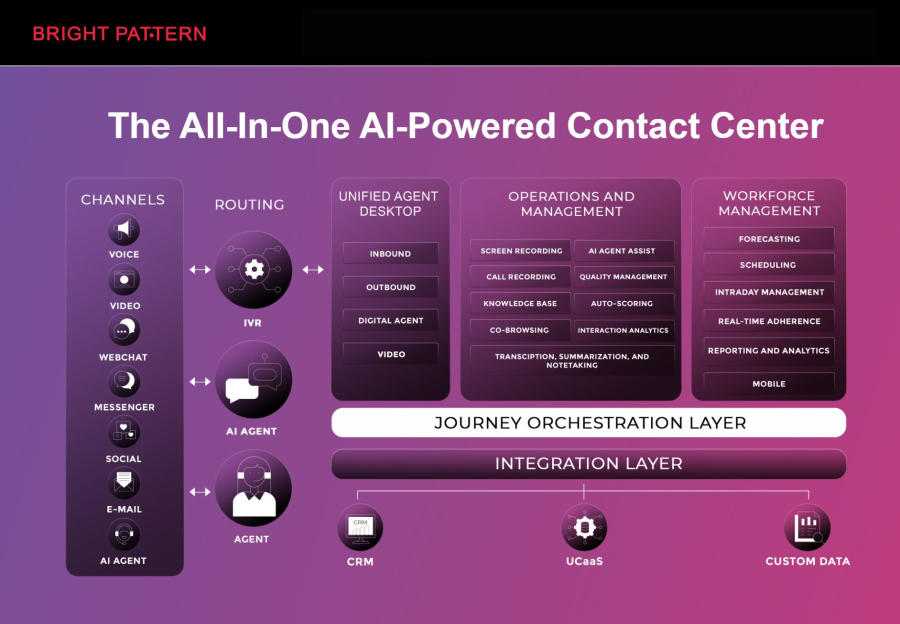
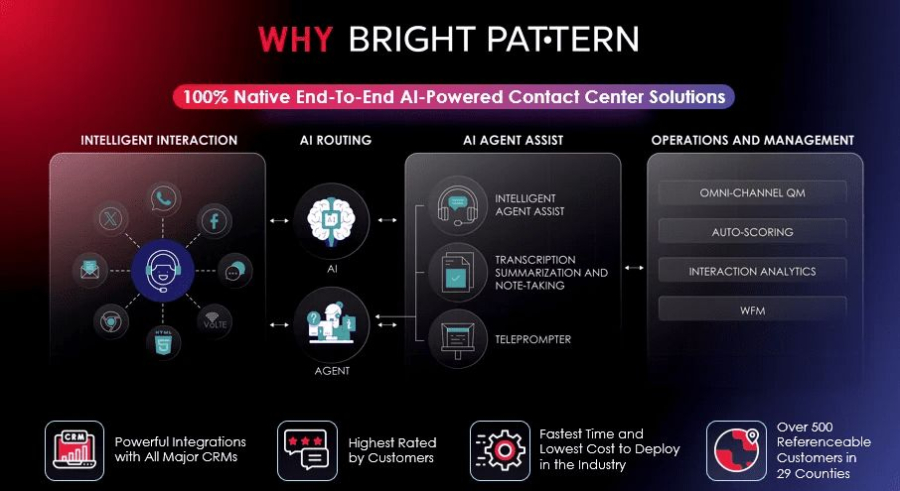
Bright Pattern provides a cloud-based contact center platform designed to improve customer experiences and empower agents. Its AI-driven capabilities include real-time agent assistance, omnichannel support, and advanced analytics.
Key Features:
- Real-time agent assist software integration for faster customer resolutions
- Predictive routing to connect customers with the best-qualified agent
- Omnichannel support including chat, voice, SMS, and social media
- Advanced analytics and reporting to monitor performance and optimize operations
- Easy integration with CRM, marketing, and back-office systems
Bright Pattern’s platform helps organizations reduce agent stress, improve response times, and deliver consistent service across channels, making it ideal for modern AI-driven contact centers.
2. Five9
Five9 offers a cloud contact center solution with AI capabilities to assist agents in real time. It focuses on improving efficiency, automating repetitive tasks, and providing predictive insights to improve customer satisfaction.
3. Genesys Cloud CX
Genesys Cloud CX provides AI-powered tools for call centers, including automated workflows, virtual assistants, and real-time guidance to agents, ensuring more effective and consistent customer interactions.
4. Talkdesk
Talkdesk’s contact center platform features AI-driven agent support, smart routing, and omnichannel capabilities. It also includes reporting tools to measure performance and customer engagement.
5. NICE inContact CXone
CXone by NICE inContact integrates AI for agent assist, customer journey analytics, and intelligent routing, helping teams deliver personalized support while reducing operational costs.
6. RingCentral Contact Center
RingCentral offers cloud-based contact center solutions with AI features such as agent recommendations, real-time transcription, and automated insights to improve service quality.
7. 8x8 Contact Center
8x8 provides AI-powered call center solutions that enhance agent efficiency with predictive analytics, real-time coaching, and automated quality management tools.
8. Zendesk Support Suite
Zendesk combines AI, automation, and workflow tools to assist agents, streamline customer inquiries, and deliver consistent service across multiple channels.
9. Freshworks Contact Center
Freshworks integrates AI for smart assistance, automated workflows, and customer sentiment analysis, helping agents handle queries faster and more effectively.
10. Avaya OneCloud
Avaya OneCloud provides AI-enhanced contact center solutions with real-time agent guidance, predictive analytics, and integration with enterprise applications for seamless service delivery.
What Is Agent Assist Software?
Agent assist software is a category of AI-powered tools that provide real-time guidance, content, and recommendations to human agents while they handle customer interactions. It acts as a digital co-pilot, listening to or reading the conversation and surfacing exactly what the agent needs in the moment.
While the customer still interacts with a human, the agent is continually supported by the software, which can:
- Suggest relevant answers and knowledge articles based on what the customer is asking.
- Highlight key customer details or history from CRM and ticketing systems.
- Recommend next best actions, workflows, or steps to follow.
- Automate note-taking and summarization to reduce after-call work.
- Flag compliance requirements or risk signals in regulated industries.
In short, agent assist software keeps agents focused on the customer while automating the heavy lifting of finding information, following processes, and documenting the interaction.
How Agent Assist Software Works
Most modern agent assist platforms are built on top of several core technologies that work together behind the scenes:
- Natural language processing (NLP)to understand what the customer and agent are saying or typing in real time.
- Machine learning modelsthat recognize patterns in questions, issues, and resolutions to suggest the best answers.
- Knowledge retrievalthat pulls content from knowledge bases, FAQs, policy documents, and previous tickets.
- Business rules and workflowsthat guide agents through the right compliance steps or internal procedures.
- Integrationswith CRMs, ticketing tools, telephony systems, and collaboration platforms.
The process typically looks like this during a live interaction:
- The customer asks a question via voice or chat.
- The software analyzes the conversation in real time.
- Relevant suggestions, snippets, and actions appear instantly in the agent’s console.
- The agent chooses the best response, personalizes it, and sends it to the customer.
- The system can automatically summarize the interaction and log key details.
Agents stay in full control, but they no longer start from a blank page or waste time hunting for information.
Key Benefits of Agent Assist Software
When implemented thoughtfully, agent assist software delivers powerful outcomes across customer experience, employee experience, and operational performance.
1. Faster, More Accurate Responses
With instant answer suggestions and guided workflows, agents can resolve issues significantly faster. They no longer need to:
- Search across multiple knowledge systems during a call.
- Ask colleagues for common answers.
- Put customers on hold while they track down information.
This leads to lower average handle time, shorter queues, and a smoother experience for customers who feel heard, not hurried.
2. Empowered, Confident Agents
Agent assist removes a huge amount of cognitive load. Instead of worrying about missing steps or giving the wrong information, agents get real-time guidance tailored to the conversation. That:
- Builds confidence, especially for new hires.
- Reduces stress and burnout in high-volume environments.
- Improves job satisfaction and retention.
Agents can spend more time focusing on empathy, tone, and relationship-building, which are uniquely human strengths.
3. Consistent Customer Experience at Scale
When every agent has the same AI co-pilot, answers and processes become more consistent, regardless of who takes the call or chat. That consistency:
- Builds trust with customers.
- Reduces escalations caused by conflicting information.
- Supports brand voice and compliance standards.
Customers benefit from a reliable experience, whether they contact you at 9 a.m. on a Monday or midnight on a weekend.
4. Operational Efficiency and Cost Savings
Agent assist software helps you do more with the team you already have. By improving productivity and first-contact resolution, it can reduce:
- Average handle time (AHT).
- Repeat contacts for the same issue.
- Supervisor escalations and callbacks.
Over time, this translates into meaningful cost savings and increased capacity to handle peak volumes without compromising quality.
5. Better Training and Onboarding
Traditional agent training is front-loaded and time-consuming. New hires are expected to retain huge amounts of information before they ever speak with a customer. Agent assist flips that model by providing in-the-moment guidance, which allows you to:
- Onboard agents faster, with less classroom time.
- Shorten the ramp-up period to full productivity.
- Reinforce best practices continuously, not just during training.
Every interaction becomes a micro-learning opportunity, supported by real-time suggestions and prompts.
6. Insights and Continuous Improvement
Because agent assist tools see every interaction in detail, they generate rich insights about what customers ask, which answers work best, and where processes break down. These insights can help you:
- Identify gaps in your knowledge base.
- Spot emerging issues before they become widespread problems.
- Refine scripts, policies, and self-service content.
Over time, your entire support operation becomes smarter and more proactive.
Core Features to Look For in Agent Assist Software
Not all agent assist platforms are the same. When evaluating options, look for features that directly support your agents and your customers.
Real-Time Guidance and Suggestions
- Contextual answer suggestionsbased on the live conversation.
- Knowledge surfacingfrom internal documents, FAQs, and help centers.
- Next best action promptsthat guide agents through multi-step processes.
Intelligent Automation
- Automatic call or chat summarizationto reduce after-call work.
- Auto-population of ticket fieldswith relevant details.
- Smart routing recommendationsfor escalations when needed.
Omnichannel Support
- Support forvoice, chat, email, and messaging channelsin a unified interface.
- Consistency of guidance regardless of interaction channel.
Integrations and Data Connectivity
- Pre-built or configurableintegrations with CRM and ticketing tools.
- Connections toknowledge management systems and document repositories.
- Ability to leverageconversation history and customer contextin suggestions.
Security, Compliance, and Governance
- Robustdata security controlsand encryption.
- Tools to manageaccess, permissions, and content approvals.
- Support for industry-specificcompliance and audit requirementswhere applicable.
Analytics and Reporting
- Insights intoagent adoption and usage.
- Metrics onresolution times, FCR, and customer sentiment.
- Feedback loops to improveknowledge content and AI models.
Agent Assist vs. Traditional Support: A Side-by-Side View
The transformation that agent assist delivers becomes clear when you compare a typical interaction with and without support from AI.
| Aspect | Without Agent Assist | With Agent Assist |
| Finding answers | Manual search across systems; high variance between agents. | Instant suggestions based on conversation and context. |
| Customer wait time | Frequent holds or delays while agent gathers information. | Reduced holds; smoother, more natural flow. |
| Compliance | Relies on agent memory and training alone. | Real-time prompts and required steps surface automatically. |
| Agent workload | High cognitive load and heavy after-call work. | Lower cognitive strain with automated summaries and guidance. |
| Consistency | Varies by agent experience and tenure. | Standardized, guided answers that reflect best practices. |
Common Use Cases for Agent Assist Software
Agent assist is valuable across many teams and industries. Here are some of the most impactful use cases.
Contact Centers and Customer Support
For high-volume contact centers, agent assist can be a game changer. It helps agents quickly handle billing questions, troubleshooting steps, account changes, and service updates across voice and digital channels. Supervisors can also use insights from the system to coach agents and refine scripts.
IT and Internal Help Desks
Internal support teams field repetitive questions and complex technical issues. Agent assist can surface known resolutions from past tickets, link to relevant documentation, and recommend diagnostic steps, which reduces time to resolution and minimizes interruptions for specialists.
Sales and Revenue Teams
In sales or customer success conversations, agents often need product details, pricing rules, or contract information. Agent assist can provide real-time prompts, objection-handling guidance, and up-sell or cross-sell suggestions, enabling more confident and consistent revenue conversations.
Back-Office and Operations Teams
Back-office teams handling claims, verifications, underwriting, or complex approvals can benefit from guided workflows and automated documentation. Agent assist ensures that the right steps are followed and that critical details are captured every time.
What a Conversation with Agent Assist Looks Like
To illustrate the experience, here is a simplified example of how an agent might interact with agent assist during a support chat:
Customer: I was double-charged on my last invoice. Can you fix it? Agent Assist: Suggests "Billing double-charge" workflow and pulls up relevant policy + step-by-step resolution. Agent: Follows steps, confirms charges, and issues a credit. Agent Assist: Generates a short summary and proposed ticket notes for the agent to confirm.
The agent stays in control and uses judgment and empathy, while the software handles the heavy lifting of searching policies and documenting the outcome.
Best Practices for Implementing Agent Assist Software
A successful rollout is about more than just technology. It requires thoughtful planning, strong content, and clear communication with your teams.
1. Start with High-Impact Use Cases
Begin where you can quickly demonstrate value, such as:
- Top 20 most frequent contact reasons.
- Complex but repetitive workflows (for example, refunds or account updates).
- Areas with high error rates or long handle times.
Quick wins build internal trust and make it easier to expand the use of agent assist to additional teams and scenarios.
2. Invest in Strong Knowledge Content
Agent assist is only as good as the information it can access. Review and refine your knowledge base, FAQs, and process documents so that:
- Articles are accurate, concise, and easy to understand.
- Policies are up to date and clearly documented.
- Common workflows are standardized and well-defined.
As the system highlights gaps, continuously enrich your content to improve suggestions and coverage.
3. Co-Design with Agents
Involve front-line agents early. Ask them:
- Which parts of their job are most repetitive or frustrating.
- Where they spend the most time searching for answers.
- What an ideal in-console experience would look like.
When agents feel heard and see the software designed around their needs, adoption and satisfaction rise dramatically.
4. Provide Clear Training and Expectations
Introduce agent assist as a supportive co-pilot, not a replacement. Training should cover:
- How suggestions are generated and how to apply judgment.
- When to rely on the system versus escalate or double-check.
- How to give feedback on inaccurate or missing suggestions.
This builds trust in the tool and encourages healthy collaboration between human agents and AI.
5. Start Small, Then Scale
Use a phased rollout:
- Pilot with a small group or one queue.
- Measure impact on KPIs like AHT, FCR, and CSAT.
- Gather qualitative feedback from agents and supervisors.
- Refine content, workflows, and configuration.
- Expand to more teams and channels.
This approach reduces risk and ensures that each subsequent phase benefits from what you learned earlier.
Driving Adoption and Change Management
Adoption is where the real value of agent assist is created. Focus your change management efforts on these areas:
- Leadership alignmentso managers and supervisors actively reinforce use of the tool.
- Transparent communicationabout the goals and expected benefits for agents and customers.
- Continuous coachingthat celebrates wins and showcases success stories.
- Feedback channelswhere agents can report issues and suggest improvements.
When agents see that the software genuinely makes their work easier, adoption follows naturally.
Measuring Success: KPIs for Agent Assist Software
To demonstrate the value of your investment, track a mix of operational, customer, and employee metrics before and after implementation.
Operational Metrics
- Average handle time (AHT).
- First-contact resolution (FCR) rate.
- Transfer and escalation rates.
- After-call work (ACW) duration.
Customer Experience Metrics
- Customer satisfaction (CSAT) scores.
- Net Promoter Score (NPS).
- Customer effort scores or qualitative feedback.
Employee Experience Metrics
- Agent satisfaction and engagement scores.
- Agent ramp-up time for new hires.
- Turnover and absenteeism trends.
Combining quantitative and qualitative data will give you a complete picture of the impact of agent assist on your organization.
How to Choose the Right Agent Assist Software
Selecting the right platform is a strategic decision. Use these criteria to guide your evaluation:
- Alignment with your use cases: Can it handle your most common and complex interactions effectively?
- Ease of use for agents: Is the interface intuitive and minimally disruptive to current workflows?
- Integration capabilities: Does it connect cleanly with your existing systems and data sources?
- Customization and control: Can you configure prompts, workflows, and content without heavy development?
- Scalability and performance: Will it handle your volume today and as you grow?
- Security and governance: Does it meet your security, privacy, and compliance requirements?
- Vendor partnership: Will you have access to support, best practices, and ongoing innovation?
A structured evaluation process, involving stakeholders from operations, IT, compliance, and front-line teams, will help you make a confident and informed choice.
Getting Started: A Simple Roadmap
If you are ready to explore agent assist software, you can move forward in a focused, low-risk way.
- Clarify your goals: Decide which metrics matter most (for example, AHT, CSAT, agent ramp time).
- Map your top use cases: Identify high-volume and high-impact interaction types.
- Assess your content: Review existing knowledge and documentation; plan quick improvements.
- Engage a cross-functional team: Include operations, IT, compliance, and representative agents.
- Run a focused pilot: Start small, measure, iterate, and refine.
- Scale with confidence: Expand to more teams, channels, and workflows as you demonstrate value.
By following this roadmap, you can quickly move from experimentation to tangible improvements in customer experience and operational performance.
The Future of Customer Service with Agent Assist
Agent assist software is not about replacing human agents; it is about amplifying their strengths. As AI capabilities continue to advance, the most successful organizations will be those that pair smart technology with skilled, empathetic people.
When every agent has an intelligent co-pilot, your organization can respond faster, personalize at scale, and deliver the kind of seamless service that keeps customers coming back. Investing in agent assist today lays the foundation for a more resilient, efficient, and customer-centric operation tomorrow.
